Choosing between a website and social media as your main platform
November 3, 2026 · Getting Online · David Semones
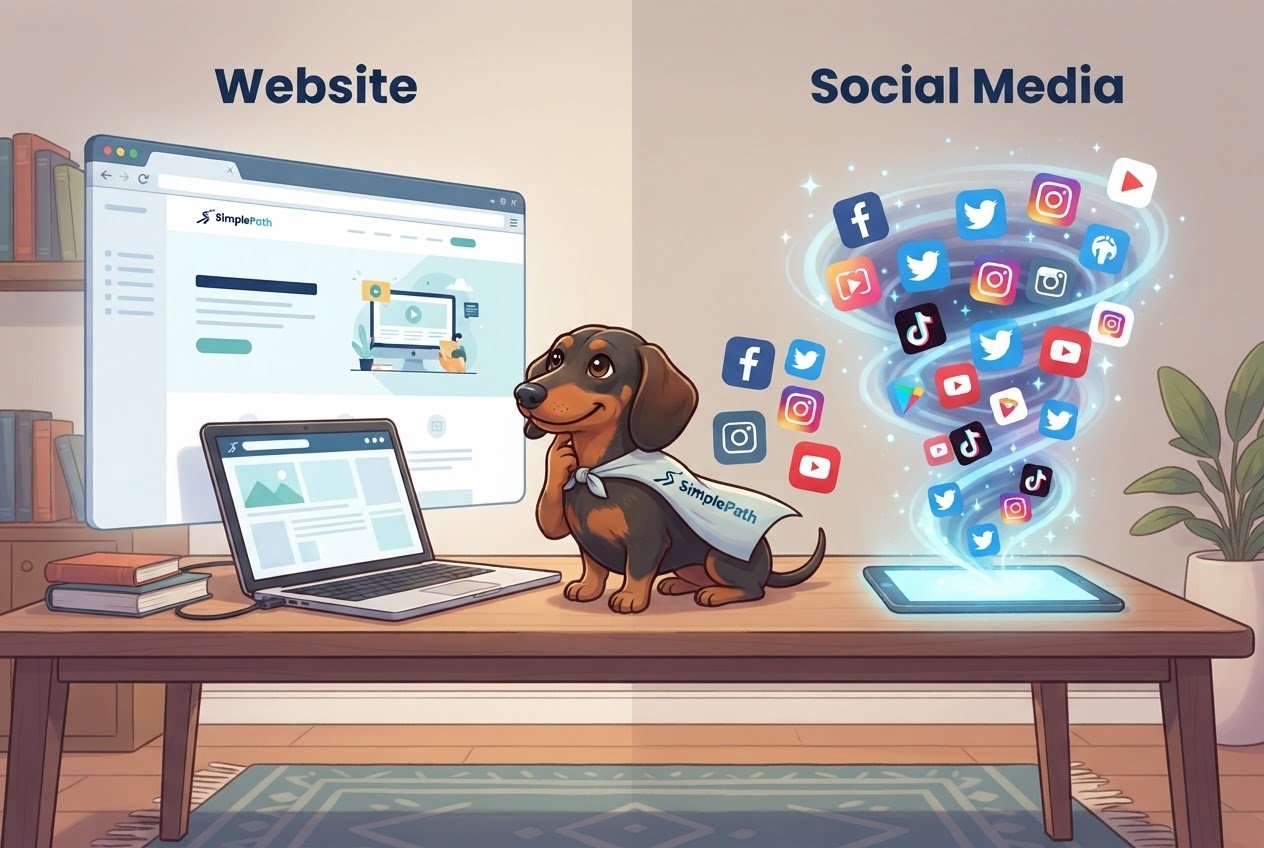
For most people and small businesses, your website should be your main platform, and social media should be one of the ways people find it. A website is the one place online that you own and control. Social media is a place you borrow. You can use both, but if you have to pick a home base, pick the website.
That's the short answer. Here's the reasoning, plus a simple way to decide if your situation is a little different.
Why a website works better as your home base
Think of it like a shop. A social media profile is a stall at a busy market. It gets foot traffic, but the market sets the rules, can move your stall, and can close the whole market tomorrow. A website is your own storefront with your name on the door.
Here's what that means in practice:
- You own it. If a social platform changes its rules, shuts down your account, or drops your posts from people's feeds, you can lose your audience overnight. A website stays put.
- People can find it by searching. When someone types a question into Google, a website can show up as an answer. Getting your site to appear there is what people mean by SEO (search engine optimization). Social posts are much harder to find once they scroll out of view.
- AI assistants can read it. Tools like ChatGPT increasingly answer questions by pulling from web pages. A clear page that says what you do, where, and for whom is something they can quote. A string of short posts rarely gives them the same thing.
- It looks established. Many people check for a website before they trust a business with money, even if they first heard about you on Instagram.
- You can do more with it. A website can take bookings, sell products, run a blog, or host a members-only area. A social profile mostly lets people look and follow.
What social media does better than a website
Social media isn't the lesser option. It does a different job, and it does some things better.
It's good at reaching people who weren't looking for you. Nobody searches for a business they've never heard of, but they might stop scrolling on a good photo or video. It's also good for quick updates, showing your personality, and chatting with customers. A website is quieter. People generally arrive on purpose.
So the two work as a team. Social media gets attention. Your website is where that attention turns into something: an enquiry, a sale, a signup.
A simple rule for deciding
If you're still unsure, use these rules.
- If people pay you, book you, or need to trust you before they buy, start with a website. That covers most service businesses, shops, and anyone selling something.
- If you want people to find you through a search, start with a website. Social posts don't do this reliably.
- If you're only sharing a hobby, building an audience, or testing an idea, social media alone is fine for now. Just plan to add a website once people start asking where else to find you.
- If your customers all live on one platform and you sell there already (some craft sellers and local food businesses, for example), social media can carry you for a while. Still, put up a simple website as a backup, in case the account disappears.
One more check: if losing your social account tomorrow would hurt your income, you've leaned on it too much, and a website is overdue.
How to use both without doubling your work
The good news is that this doesn't need to be a lot of effort. A sensible setup looks like this:
- Build a small website first. A homepage that says what you do, who it's for, and how to contact you is a solid start. Add more pages as you need them.
- Put your website address in every social profile so people have somewhere to go next.
- Post on one or two social platforms, not five. Pick where your customers actually spend time.
- Share links back to your site, such as a new blog post, product, or offer, instead of leaving everything on the platform.
The usual worry is that building a website means learning code or hiring a developer. It doesn't have to. SimplePath is an AI-led website builder where you describe the site you want and it builds it for you, so you don't need to know HTML or CSS (the languages websites are written in). You can see what SimplePath can build, from simple sites to stores, blogs, and member areas, and check what each plan includes before you commit to anything.
If you already have a website but aren't sure it's pulling its weight, the free website grader will score it and show you where to improve.
Your next step
Keep your social accounts, but give them a home to send people to. If you'd like to talk through which setup fits you, get in touch with us and we'll help you work it out.
Drafted with SimplePath's own AI blog, then updated and published by David before it went up. It's the same tool included with the Grow plan. See how it works.